Decipherment of Egyptian Hieroglyphs
◈Key Scholars
Completed the decipherment using his knowledge of Coptic.
First identified that cartouches represented royal names phonetically.
◈How Was It Deciphered?
Champollion discovered three principles. First, signs inside cartouches (oval rings) spell pharaohs' names phonetically. Second, hieroglyphs are a mixed system — some signs represent meanings (ideographs), others represent sounds (phonograms). Third, Coptic (the language of modern Egyptian Christians) directly preserves ancient Egyptian pronunciation. With these three keys, he began assigning phonetic values like an alphabet.
◈Decoded Characters
Cartouche 𓇋𓇋𓏏𓊃𓏏𓇋𓇋 = "Kleopatra (Cleopatra)" — each sign represents the sounds k·l·e·o·p·a·t·r·a.
◈Full Original Translation
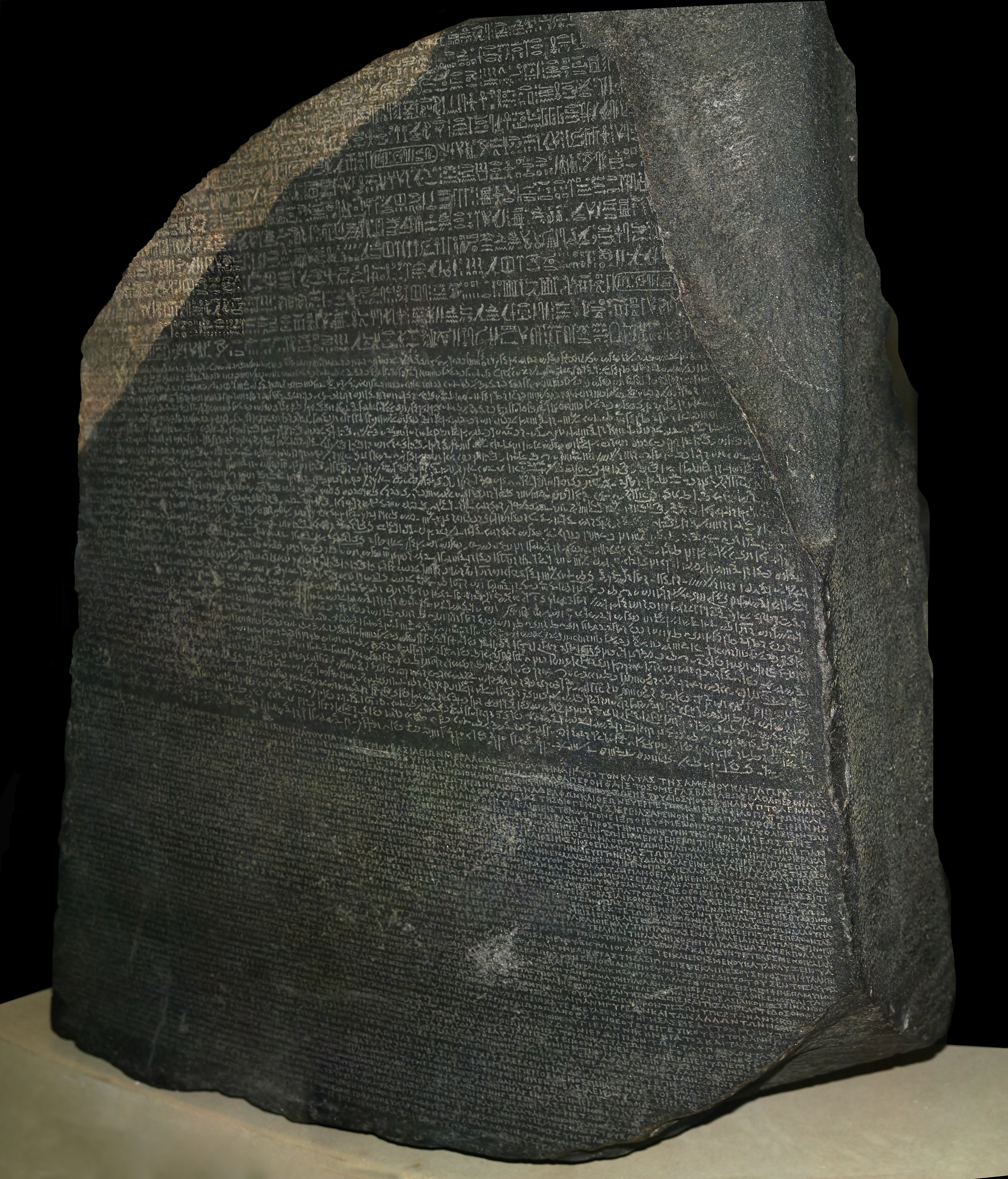
The Rosetta Stone — Memphis Decree (27 March, 196 BC)
【Preamble】 In the reign of the young king who hath received the kingship from his father, lord of crowns, glorious, who hath established Egypt and is pious toward the gods — Ptolemy V Epiphanes Eucharistos, beloved of Ptah — in the 9th year, 4th month of winter, day 18. The priests of all the temples of the land, assembled at Memphis, have decreed as follows:
【Benefaction 1 — Temple Support】 Whereas King Ptolemy hath endowed the temples with revenues in money and grain, hath spared no expense to bring prosperity to Egypt, hath restored to their former state the offerings of bulls, geese, and fowl, and hath dedicated rich gifts to all sanctuaries.
【Benefaction 2 — Tax Relief】 Whereas he hath remitted the tax which the priests paid upon entering the temple service, lessened the cloth-tax on temple linen-makers, and repealed the new levies which had been imposed.
【Benefaction 3 — Amnesty】 Whereas he hath released those who were in prison and those long under accusation, hath pardoned soldiers who had deserted, and hath returned them to their families and possessions; and hath relieved the burden of naval conscription.
【Benefaction 4 — Pacification】 Whereas he hath subdued the rebels at Lycopolis, punished those who had violated the temples, and restored peace throughout the land of Egypt.
【Decree of the Priests — Apotheosis】 It hath therefore seemed good to the priests of all the temples of Egypt, that all the honors due to King Ptolemy V Epiphanes Eucharistos shall be greatly increased: a statue of the king shall be set up in the most prominent place in every temple, called "Ptolemy, defender of Egypt." Sacrifices shall be offered before it three times a day, and his birthday and accession-day shall be observed as monthly festivals.
【Publication Clause】 And this decree shall be inscribed on a stela of hard stone in sacred (hieroglyphic), native (Demotic), and Greek characters, and set up in each of the temples of the first, second, and third rank, beside the image of the ever-living king.
◈The Full Story
In AD 394, the last hieroglyphic inscription was carved at the Temple of Philae. For the next 1,400 years, no one could read it. As Rome adopted Christianity, pagan temples were closed and the priestly class who knew hieroglyphs vanished. Medieval Arab scholars believed the signs were pure pictures or magical symbols. Renaissance Europe viewed them as indecipherable sacred mysteries.
In 1799, Napoleon's expedition discovered the Rosetta Stone bearing the same decree in three scripts. Thomas Young established in 1814 that cartouches spelled pharaohs' names phonetically. The decisive breakthrough came from Champollion, who had taught himself Coptic as a child. On September 14, 1822, he grasped that hieroglyphs were a mixed system. Legend has it he burst into his brother's office crying "Je tiens l'affaire!" before collapsing in a faint.
Champollion's decipherment gave birth to Egyptology. Tutankhamun's tomb, Abu Simbel, the Book of the Dead — all became readable. Champollion died of overwork at 41, but the door he opened forever changed how humanity understands its own origins.