Decipherment of Linear B
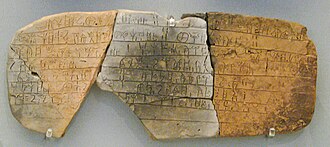
◈Key Scholars
British archaeologist. In 1900 he discovered the Minoan civilization and Linear B tablets at Knossos, Crete. For 50 years he insisted "Linear B is not Greek" and rarely released the tablet facsimiles, delaying decipherment.
Classics professor at Brooklyn College. She filled 400,000 index cards to find patterns of word-ending variation, proving Linear B was an inflected language. Died of lung cancer at 43 in 1950 — never seeing the answer — but her grid became the foundation for Ventris's decipherment.
Amateur linguist trained as an architect. At age 14 (1936) he heard a lecture by Arthur Evans and devoted his life to Linear B. Spoke 6 languages. Cracked the code on 28 June 1952, just before his 30th birthday; announced it on BBC Radio on 1 July. Died in a car accident on 6 September 1956 at age 34 — just three weeks before the publication of "Documents in Mycenaean Greek" co-authored with John Chadwick at Cambridge.
Cambridge classicist who verified Ventris's 1952 decipherment in a month-long examination, then began their collaboration. Co-authored "Documents in Mycenaean Greek" (1956), the standard work on Mycenaean Greek.
◈How Was It Deciphered?
Kober filled 400,000 index cards to find patterns of word-ending variation — characteristic of an inflected language. Ventris developed a 'grid analysis': he arranged words sharing a root but with different endings in a grid, cross-inferring the phonetic values of shared signs. Using place names from Crete (Knossos, Amnisos, Tulissos) as anchors, he fixed a few values and solved the rest in a chain reaction. The decoded words — TI-RI-PO (tripod), WA-NA-KA (king/wanax), PO-ME (shepherd), DI-WE (Zeus), PO-SE-DA-O (Poseidon), A-TA-NA (Athena), E-RA (Hera) — were all archaic Greek.
◈Decoded Characters
𐀒𐀜𐀰𐀄𐀰 = ko-no-so = "Knossos" — the place name Ventris used to confirm phonetic values decisively.
◈The Full Story
In 1900, Arthur Evans excavated Knossos and found thousands of clay tablets. The scholarly consensus held that Linear B recorded a unique Minoan language unrelated to any Indo-European tongue. Professional linguists had made no progress for decades.
In June 1952, Ventris proposed the language was Greek. Scholars laughed — but the analysis held. Linear B recorded archaic Greek from around 1400 BC.
The decipherment pushed back Greek history by over 300 years. Tragically, Ventris died in a car accident at 34, just four years later. Linear A remains undeciphered.