SCRIPTA
IFront MatterIIPrimary Artifact★Featured TextsIIIThe LettersVMechanicsVILineageVIIIn the World
I

Front Matter

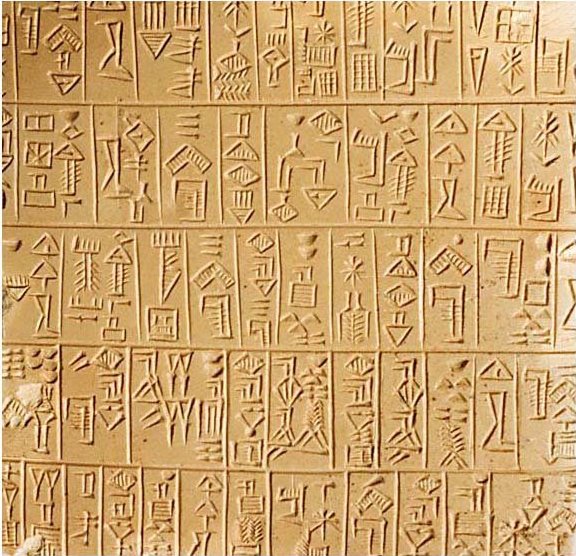
Sumerian cuneiform

Uruk, 3500 BC — humanity's first writing. From temple ledgers to the Epic of Gilgamesh.

𒀭 𒁹 𒅁 𒊑 𒄑 𒂗 𒍪 𒋾
Era
Ancient (3500 BC — 100 BC)
Region
Mesopotamia
System
Logo-syllabic
Medium
Clay tablet + reed stylus
Signs
~600 signs
Status
Extinct · Deciphered
The world's first writing system, invented in Uruk around 3500 BC. Originally pictographic records for temple grain and livestock, it evolved into wedge-shaped marks pressed into clay with a reed stylus. The Sumerians invented the world's first school (edubba) simultaneously. The Epic of Gilgamesh and the world's first written laws (precursor to the Code of Hammurabi) were recorded in this script. After Sumerian died as a spoken language, the writing system was adapted for 15+ languages — Akkadian, Babylonian, Assyrian, Old Persian, Elamite — and reigned as Mesopotamia's standard script for ~2,800 years (3400–600 BC).
3,500 Years of Cuneiform
From pictures to alphabet
BC 3500
Invention
Pictographs (proto-cuneiform) emerge at Uruk for temple accounting.
BC 2900
Wedge form
Reed stylus on clay standardizes the wedge shape.
BC 2400
Birth of literature
Major literary works including the Epic of Gilgamesh recorded.
BC 1750
Code of Hammurabi
The world's first written code — 282 laws on a black diorite stele.
AD 75
Last record
An astronomical tablet — the last known use. 1,800 years of silence follow.
1857
Decipherment
British scholars decipher cuneiform via the trilingual Behistun Inscription.
II

Primary Artifact

Proto-cuneiform tablet
c. 3100–2900 BC · from Adab · Walters Art Museum
FullFull
TopTop
BottomBottom
— A land-transfer record. Among the oldest accounting documents in human history.
Periodc. BC 3100–2900
MaterialClay
ContentLand transfer
CollectionWalters · Baltimore
A clay tablet from early Sumerian civilization, written in proto-cuneiform pictographs. Temple economy accounting was the direct motive for inventing writing. The reed-stylus-on-wet-clay technique was used across Mesopotamia for the next 3,000 years.
★

Featured Texts

Original · Translation
Featured Texts
The earliest literature, in Sumerian

Nin-me-šara — The Exaltation of Inanna

c. BC 2285
AuthorEnheduanna (daughter of Sargon, high priestess of Ur)
LanguageSumerian
nin me šár-ra ud dalla è-a
Lady of all the divine powers, resplendent light,
munus zi me-lám gùr-ru ki ág an uraš-a
righteous woman clothed in radiance, beloved of An and Uraš,
nu-gig an-na suh-keš-da gal-gal
hierodule of An, you of all the great ornaments,
aga zi-da ki ág nam-en-na tum-ma
who loves the right tiara, fit for high priesthood,
me-bi imin-bi šu sá du₁₁-ga
who has grasped all seven of its divine powers in your hand.
The first author known by name in human history. Daughter of Sargon of Akkad and high priestess of Nanna at Ur, Enheduanna composed in Sumerian and recorded her hymns on cuneiform tablets — the conqueror's daughter praising the gods in the language of the conquered, the canonical starting point of Mesopotamian literature.
— ETCSL 4.07.2 · Hallo & van Dijk (1968)

Gilgamesh and Huwawa (Sumerian version)

c. BC 2100 (우르 제3왕조)
LanguageSumerian
en-e kur lú til₃-la-šè ĝeštug₂-ga-ni na-an-gub
The lord set his mind toward the Mountain of the Living;
en ᵈbil₃-ga-mes kur lú til₃-la-šè ĝeštug₂-ga-ni na-an-gub
Lord Bilgames set his mind toward the Mountain of the Living.
ìr-ra-ni en-ki-du₁₀-ra gù mu-na-dé-e
He spoke to his servant Enkidu:
en-ki-du₁₀ a-ba-am₃ an-šè ba-e₁₁-dè
"Enkidu, who can ascend to heaven?
lú dim₃-ma-bi ki-a ḫa-ba-an-šub
Only the gods dwell with Utu forever — mortal kind is brief."
A Sumerian poem that became the prototype for Tablet III (the cedar forest expedition) of the later Akkadian Standard Babylonian Epic. Copied as a scribal exercise in the edubba schools of the Ur III and Isin-Larsa periods; the Akkadian synthesis that grew from it became humanity's first heroic epic.
— ETCSL 1.8.1.5 · Nippur tablets
III

The Letters

Signs · Unicode · Types
Sample GlyphsClick to copy
Unicode
Range 1U+12000–U+123FF
Range 2U+12400–U+1247F
Total signs600
In Unicode1,234
Unicode Blocks
Cuneiform
12000 – 123FF
922 chars→
Cuneiform Numbers
12400 – 1247F
116 chars→
Early Dynastic Cuneiform
12480 – 1254F
196 chars→
Glyph evolution
Form change over time
Loading evolution data…
V

Reading Mechanics

Direction · Method
↔
Direction
Left to Right (LTR)
좌→우 (LTR)
α
System
Logographic
⌨
Input method
Direct Unicode input
Keyboard layout
Standard IME · input chart
Keyboard layout data not yet available.
VI

The Lineage

Family · Descendants
Phylogeny
Descendants of hieroglyphs
Phylogeny
Related scripts
Ancestors · Descendants · Family

Ancestors

Proto-Symbols

Descendants

Akkadian Cuneiform

Same family

Akkadian CuneiformOld Persian CuneiformOld Persian Cuneiform
VII

In the World

Usage · Reach

Languages

Sumerian

Countries

Iraq
Reach of cuneiform
Used across Mesopotamia for 3,000 years
Sumerian1,400y
Akkadian2,000y
Babylonian1,800y
Assyrian1,500y
Hittite450y
Major museums
𒈗
British Museum
London
𒌷
Louvre
Paris
𒀭
Pergamon · Vorderasiatisches
Berlin
𒂍
Iraq Museum
Baghdad
Living legacy
~500K
Clay tablets
Estimated total preserved worldwide
1857
Year of decipherment
Cracked via Behistun trilingual
BC 3500
Origin
Humanity's first writing — Uruk
3,500y
Lifespan
From invention to last tablet