マヤ文字の解読
◈解読に貢献した人物
1839年、アメリカの弁護士・外交官。グアテマラ・ホンジュラスの密林に眠っていた巨大なマヤの石造都市を発見し、西欧学界に初めて知らせた人物。『中央アメリカ・チアパス・ユカタン旅行記』(1841)がマヤ考古学の出発点になった。
20世紀英国マヤ学の絶対的権威。「マヤ文字は漢字のような表意文字で、音声とは無関係だ」と断言したその仮説が100年間定説として君臨し、誰もマヤ碑文を一行も読めなくした。クノロゾフの音節仮説を最後まで拒んだ。
メキシコの考古学者。1952年、パレンケ「碑文の神殿」の床下に秘密の通路を発見し、4年の発掘の末、パカル大王の石棺に到達した。マヤ王の墓がピラミッド内部にあることを初めて立証。
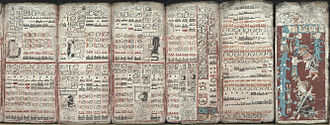
スペインのフランシスコ会修道士。1562年、ユカタンのマニの焚書で数千巻のマヤ絵文書を焼き、ドレスデン・マドリード・パリ・グロリエの4巻だけを残した加害者。同時に、マヤの人々を尋問して記録した「ランダのアルファベット」が、400年後クノロゾフの解読の決定的な手がかりになるという逆説。
マヤ文字が音節文字であることを証明。冷戦期、西側学界に黙殺されたが、結局正しかった。
マヤ王朝の歴史を碑文から復元。
◈どのように解読されたか
Maya combines syllabic signs (syllabograms) with meaning signs (logograms). Each syllabic sign represents a consonant-vowel (CV) syllable: ba, be, bi, bo, bu / ka, ke, ki, etc. The same syllable can be written with multiple different signs (homophones), which made decipherment difficult. Knorosov reinterpreted Landa's alphabet as syllabic values to crack the system.
◈実際に解読された文字
ku-tzu =「KUTZ(七面鳥)」— クノロゾフが最初に解読した単語。ba-la-ma =「BALAM(ジャガー)」— マヤ王のもっとも一般的な称号。音節記号と表語文字の全リストは下の図表を参照。
◈文字体系の図表


◈解読の前後の物語
In 1562, Spanish friar Diego de Landa burned thousands of Maya codices in the Maní auto-da-fé in Yucatán. Only four codices survived (Dresden, Madrid, Paris, Grolier). For 400 years, scholars concluded from distorted records that Maya was purely ideographic.
In 1952, Soviet linguist Knorosov proved Maya was syllabic. Dismissed during the Cold War, his theory was vindicated in the 1960s–70s when Palenque inscriptions yielded dynastic histories.
Today about 90% of Maya script can be read. Knorosov finally visited Maya sites in the 1990s.