Decipherment of Mayan Script
◈Key Scholars
In 1839, this American lawyer-diplomat brought the slumbering stone cities of the Maya — in the jungles of Guatemala and Honduras — to Western attention. His "Incidents of Travel in Central America, Chiapas and Yucatán" (1841) launched the field of Maya archaeology.
The 20th-century British authority on Maya studies. His dogma — "Maya writing is purely ideographic like Chinese, with no phonetic value" — reigned for a century and blocked anyone from reading a single line of Maya inscription. He rejected Knorosov's syllabic hypothesis to the end.
Mexican archaeologist. In 1952 he found a secret passage beneath the floor of the Temple of the Inscriptions at Palenque; after four years of excavation, he reached the sarcophagus of King Pakal in June 1952 — the first proof that Maya kings were buried inside their pyramids.
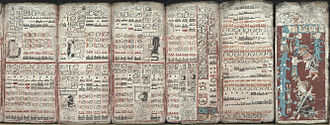
Spanish Franciscan friar. The 1562 Maní book-burning destroyed thousands of Maya codices, leaving only four (Dresden, Madrid, Paris, Grolier). Paradoxically, his "Landa alphabet" — recorded from Maya informants — became the key clue that Knorosov used to decipher the script 400 years later.
Proved Maya was syllabic. Dismissed during the Cold War — but was right.
Reconstructed Maya dynastic history from inscriptions.
◈How Was It Deciphered?
Maya combines syllabic signs (syllabograms) with meaning signs (logograms). Each syllabic sign represents a consonant-vowel (CV) syllable: ba, be, bi, bo, bu / ka, ke, ki, etc. The same syllable can be written with multiple different signs (homophones), which made decipherment difficult. Knorosov reinterpreted Landa's alphabet as syllabic values to crack the system.
◈Decoded Characters
ku-tzu = "KUTZ (turkey)" — first word decoded by Knorosov. ba-la-ma = "BALAM (jaguar)" — most common royal title. See chart images below for full syllabary and logograms.
◈Script Charts


◈The Full Story
In 1562, Spanish friar Diego de Landa burned thousands of Maya codices in the Maní auto-da-fé in Yucatán. Only four codices survived (Dresden, Madrid, Paris, Grolier). For 400 years, scholars concluded from distorted records that Maya was purely ideographic.
In 1952, Soviet linguist Knorosov proved Maya was syllabic. Dismissed during the Cold War, his theory was vindicated in the 1960s–70s when Palenque inscriptions yielded dynastic histories.
Today about 90% of Maya script can be read. Knorosov finally visited Maya sites in the 1990s.