01OVERVIEW
Front Matter
SCRIPT · PROFILE
Maya glyphs
The sacred script of Maya civilization — the language of astronomers carved on temples, awoken 400 years after the 1562 book-burning.
A complex system mixing logograms and syllabic signs — the only fully independent writing system invented in the New World. Used from the 3rd century BC until the Spanish conquest (16th century). In 1562 friar Diego de Landa burned thousands of Maya books; only four codices survived (Dresden, Madrid, Paris, Grolier). Soviet scholar Yuri Knorosov's 1952 proof of its syllabic nature opened the door to decipherment, and the script is now ~90% readable. The precision of the Maya calendar continues to astonish modern astronomers.
2,000 Years of Maya Glyphs
Birth, book-burning, rebirth
c. BC 300
Earliest glyphs
Preclassic inscriptions such as the San Bartolo murals begin the Mesoamerican writing tradition.
250–900
Classic florescence
Dynastic and astronomical records on stelae, temples, and ceramics — the age of Tikal, Palenque, Copán.
1562
Landa book-burning
Codices burned at Maní, Yucatán — only four books survive today.
1839
Rediscovery
Stephens and Catherwood first report the jungle stone cities to the West.
1952
Syllabic breakthrough
Knorosov proves the script is syllabic.
1980s~
Dynasties restored
Schele and a new generation read history off the monuments — roughly 80% deciphered.
02ARTIFACT
Primary Artifact
Palenque glyphs
7th century · Palenque temples · Chiapas, Mexico
Full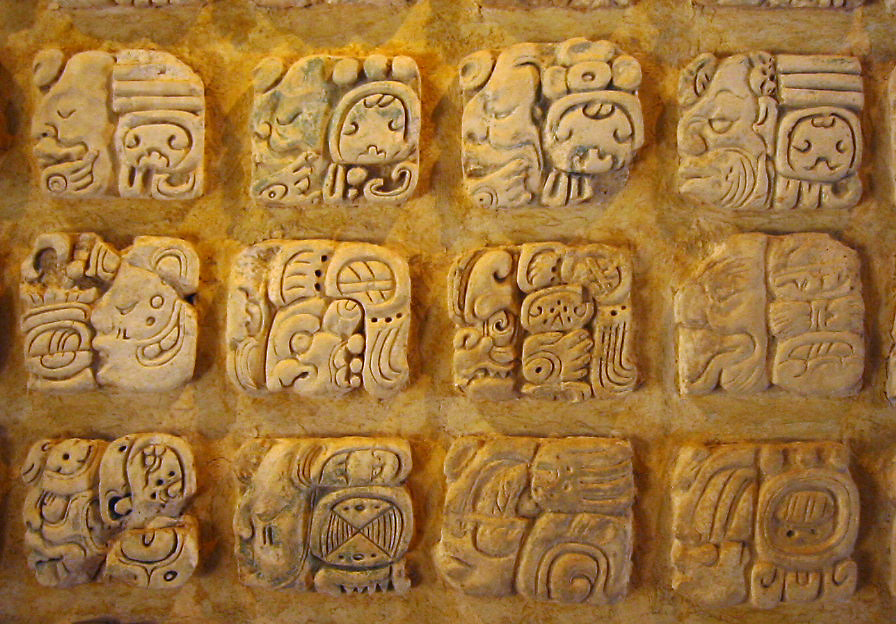
Top
Bottom
— Glyphs from the Palenque temples · inscriptions of King Pakal
Palenque is the site of the most refined surviving Maya inscriptions. The glyphs carved on the tomb and temple walls of King Pakal (7th century) are primary sources for Maya history, astronomy, and royal genealogy.
04SPECIMEN
The Letters
Signs · Unicode · TypesSample GlyphsClick to copy
Unicode
Total signs800
In Unicode20
Only 20 of 800 total signs are in Unicode — 780 remain unencoded.
Unicode Blocks
Glyph evolution
Form change over time
Loading evolution data…
05DECIPHERMENT
The Decipherment
400 years of misunderstanding (1566–1980s)Key scholars
Dresden Codex, Landa's alphabet, Palenque inscriptions
John Lloyd Stephens1805–1852
In 1839, this American lawyer-diplomat brought the slumbering stone cities of the Maya — in the jungles of Guatemala and Honduras — to Western attention. His "Incidents of Travel in Central America, Chiapas and Yucatán" (1841) launched the field of Maya archaeology.
J. Eric S. Thompson1898–1975
The 20th-century British authority on Maya studies. His dogma — "Maya writing is purely ideographic like Chinese, with no phonetic value" — reigned for a century and blocked anyone from reading a single line of Maya inscription. He rejected Knorosov's syllabic hypothesis to the end.
Alberto Ruz Lhuillier1906–1979
Mexican archaeologist. In 1952 he found a secret passage beneath the floor of the Temple of the Inscriptions at Palenque; after four years of excavation, he reached the sarcophagus of King Pakal in June 1952 — the first proof that Maya kings were buried inside their pyramids.
Diego de Landa1524–1579
Spanish Franciscan friar. The 1562 Maní book-burning destroyed thousands of Maya codices, leaving only four (Dresden, Madrid, Paris, Grolier). Paradoxically, his "Landa alphabet" — recorded from Maya informants — became the key clue that Knorosov used to decipher the script 400 years later.
Yuri Knorosov1922–1999
Proved Maya was syllabic. Dismissed during the Cold War — but was right.
Linda Schele1942–1998
Reconstructed Maya dynastic history from inscriptions.
Before
In 1562, Spanish friar Diego de Landa burned thousands of Maya codices in the Maní auto-da-fé in Yucatán. Only four codices survived (Dresden, Madrid, Paris, Grolier). For 400 years, scholars concluded from distorted records that Maya was purely ideographic.
Breakthrough
In 1952, Soviet linguist Knorosov proved Maya was syllabic. Dismissed during the Cold War, his theory was vindicated in the 1960s–70s when Palenque inscriptions yielded dynastic histories.
After
Today about 90% of Maya script can be read. Knorosov finally visited Maya sites in the 1990s.
Decoded signs
Glyph → phonetic → meaning
𝋠
𝋡
𝋥
𝋦
𝋧
𝋳
06MECHANICS
Reading Mechanics
Direction · Method↔
Direction
Left to Right (LTR)
Paired columns read left to right, then top to bottom.
α
System
Logographic
⌨
Input method
Direct Unicode input
Keyboard layout
Standard IME · input chart
Keyboard layout data not yet available.
07LINEAGE
The Lineage
Family · DescendantsPhylogeny
Ancestors & descendants
Related scripts
Ancestors · Descendants · Family
08REACH
In the World
Usage · ReachUse across the eras
From florescence through silence to revival
Maya glyphs in numbers
Glyphs · Deciphered · Codices
~800
Glyphs
~80%
Deciphered
4
Codices
Major collections
📜
SLUB Dresden (Dresden Codex)
Dresden
🏛
Museo Nacional de Antropología
Mexico City
🗿
MUNAE Guatemala
Guatemala City
🌎
Museo de América (Madrid Codex)
Madrid
Living legacy
4
Surviving codices
Dresden, Madrid, Paris, Grolier — all that survived the burning
600만+
Mayan speakers
Some 30 modern Mayan languages, with a glyph-revival education movement
2012
Long Count
The 13-baktun turnover drew global attention to Maya math and calendrics
U+
Unicode proposal
Preliminary encoding proposals under way — the next step of digital revival