01OVERVIEW
Front Matter
SCRIPT · PROFILE
Phoenician 𐤀𐤁𐤂
The mother of all alphabets — 22 letters invented by Mediterranean merchants. Alpha and beta start here.
The 22-consonant alphabet developed by Phoenician merchants of the Levant around the 11th century BC. Phoenicians did not invent writing — they streamlined Proto-Sinaitic into 22 consonants and became the "most important relay" that spread the alphabet in every direction along Mediterranean trade routes. Spread through Mediterranean trade to Greece, Italy, Carthage, and Iberia. The Greek alphabet descended from Phoenician, which then led to Latin and Cyrillic — making Phoenician the direct ancestor of alphabets used by billions today. Even the names of alphabet letters (alpha=ox, beta=house) derive from Phoenician words.
02ARTIFACT
Primary Artifact
The 22 Phoenician letters
From 𐤀 aleph to 𐤕 taw · the prototype of all alphabets
Full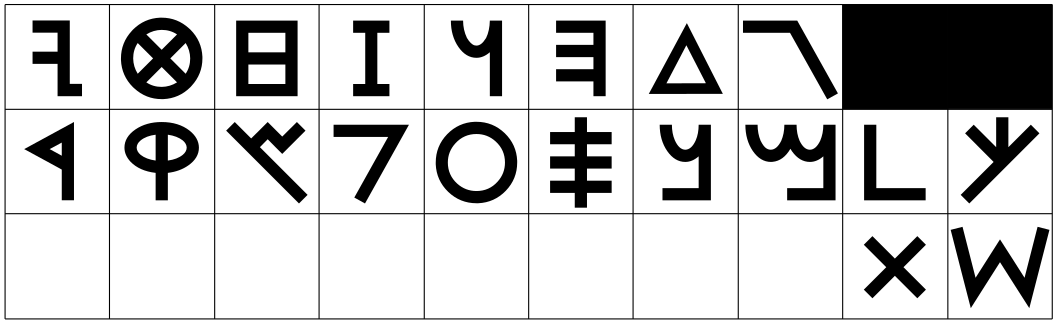
— The 22-consonant alphabet — common ancestor of Greek, Latin, Hebrew, Arabic, and Cyrillic
A practical 22-consonant alphabet invented by Phoenician merchants for Mediterranean trade. Abandoning the picture-spirit of hieroglyphs, it established the principle of "one sound = one sign" — humanity's decisive simplification of writing. The Greeks added vowels to complete the alphabet, which then branched into Latin and Cyrillic.
04SPECIMEN
The Letters
Signs · Unicode · TypesSample GlyphsClick to copy
Glyph evolution
Form change over time
Loading evolution data…
05DECIPHERMENT
The Decipherment
~1,500 years of obscurity (c. AD 300–1764)Key scholars
Greek-Phoenician bilingual inscription from Malta
Jean-Jacques Barthélemy1716–1795
First systematically deciphered Phoenician script.
Before
Phoenician civilization was erased from history after the Roman era. Carthage was destroyed, and medieval Europeans had no idea what the signs on Phoenician artifacts meant.
Breakthrough
In 1764 Barthélemy analyzed the Malta bilingual and announced Phoenician was a 22-consonant abjad.
After
The decipherment completed the genealogy of Mediterranean alphabets, proving Greek derived from Phoenician and founding comparative epigraphy.
Decoded signs
Glyph → phonetic → meaning
𐤀
𐤁
𐤂
𐤃
𐤄
𐤅
𐤆
𐤇
𐤈
𐤉
𐤊
𐤋
𐤌
𐤍
𐤎
𐤏
𐤐
𐤑
06MECHANICS
Reading Mechanics
Direction · Method↔
Direction
Right to Left (RTL)
Right to left (RTL)
α
System
Abjad
⌨
Input method
Direct Unicode input
Keyboard layout
Standard IME · input chart
Keyboard layout data not yet available.
07LINEAGE
The Lineage
Family · DescendantsPhylogeny
Ancestors & descendants
Phylogeny
Related scripts
Ancestors · Descendants · Family
08REACH